Barclays Named AI in 5,000 Job Cuts. Here's What the Bank Actually Said.
The bank's own call script tells two stories at once. Today's US layoff numbers help explain why that matters.
On October 22, Barclays said it expects to cut about 5,000 full-time jobs this year. That is roughly 5% of its staff. About 1,000 of those roles were already gone by the middle of the year, and the bank expects the other 4,000 to go by December (BBC, Banking Dive).
Almost every headline put AI in the first line. I get why. But I wanted to know what Barclays itself said, in its own documents, so I read the script and slides from its results call. It turns out the bank is telling two stories in the same breath, and only one of them is about AI doing anyone’s job.
If you work in a bank, a support team or a software team, the difference matters. It changes what you should do next.
What Barclays said, in its own words
Barclays published the speech its CEO and finance director gave to analysts, along with the slides (Barclays Q3 2026 call speech). Here is what it says about the cuts, in my words.
- The 5,000 figure comes from what Barclays calls structural cost actions taken in 2026. A footnote says the reduction is still subject to collective and individual consultation where that is required.
- Around 60% of the actions are in support functions, and that includes developers. The finance director, Anna Cross, put it this way: “fewer developers as AI makes our people more productive.”
- In the UK retail bank, better customer technology cut call centre volumes by about 10% over the past year. Technology inside the call centres made staff more productive. Branches now have about 10% fewer employees each.
- The bank expects more than £1.1bn of gross efficiency savings in 2027.
The CEO, C.S. Venkatakrishnan, was asked how many of the cuts were directly down to AI. He did not give a number. He said deep investment in technology and simpler processes were behind most of the savings so far, and that AI was “the icing on the cake, not the cake” (The Guardian).
So the bank named AI, but its own boss said AI is not the main driver yet.
Two stories in one announcement
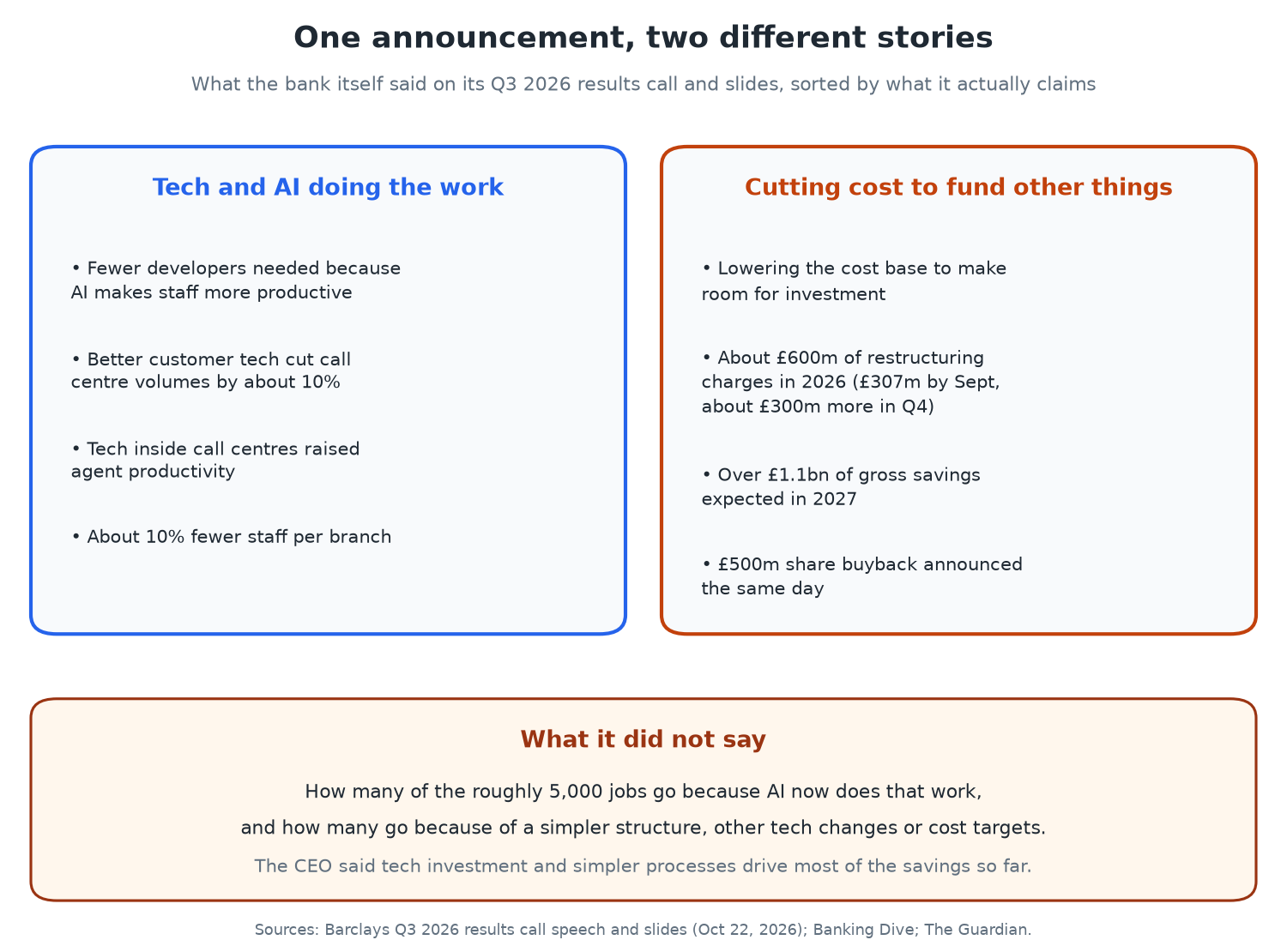
When I sort Barclays’ statements, they fall into two piles.
The first pile is technology doing work people used to do. Fewer developers because AI tools speed up the ones who stay. Fewer calls because customers use better self-service technology. Fewer people per branch. Only the developer line names AI directly. The call centre and branch changes are described as technology in general.
The second pile is about money. The slide headline says Barclays is cutting its cost base to free up room for investment. The bank had spent £307m on these restructuring actions in the first nine months of 2026 and expects about £300m more in the fourth quarter. Banking Dive points out that the full year total, over £600m, is roughly twice what Barclays first planned. On the same day, Barclays announced a £500m share buyback and a 12% rise in quarterly pre-tax profit, to £2.3bn (CNBC).
The Unite union said Barclays was using AI as an excuse, and it opened urgent talks with the bank. Its global federation, UNI, pointed straight at the buyback announced on the same day as the cuts (UNI Global Union). I don’t think “excuse” is quite fair either. The developer line is a real claim about AI changing how much work one person can do. But the bank has not said how big that part is.
What today’s US layoff report adds
This morning Challenger, Gray & Christmas published its October report on US job cut announcements. It is one of the most quoted counts of layoffs where the employer names AI (Challenger, October 2026). Barclays is a UK bank, so its cut is not what this report is about. But it shows the same pattern from the other side.
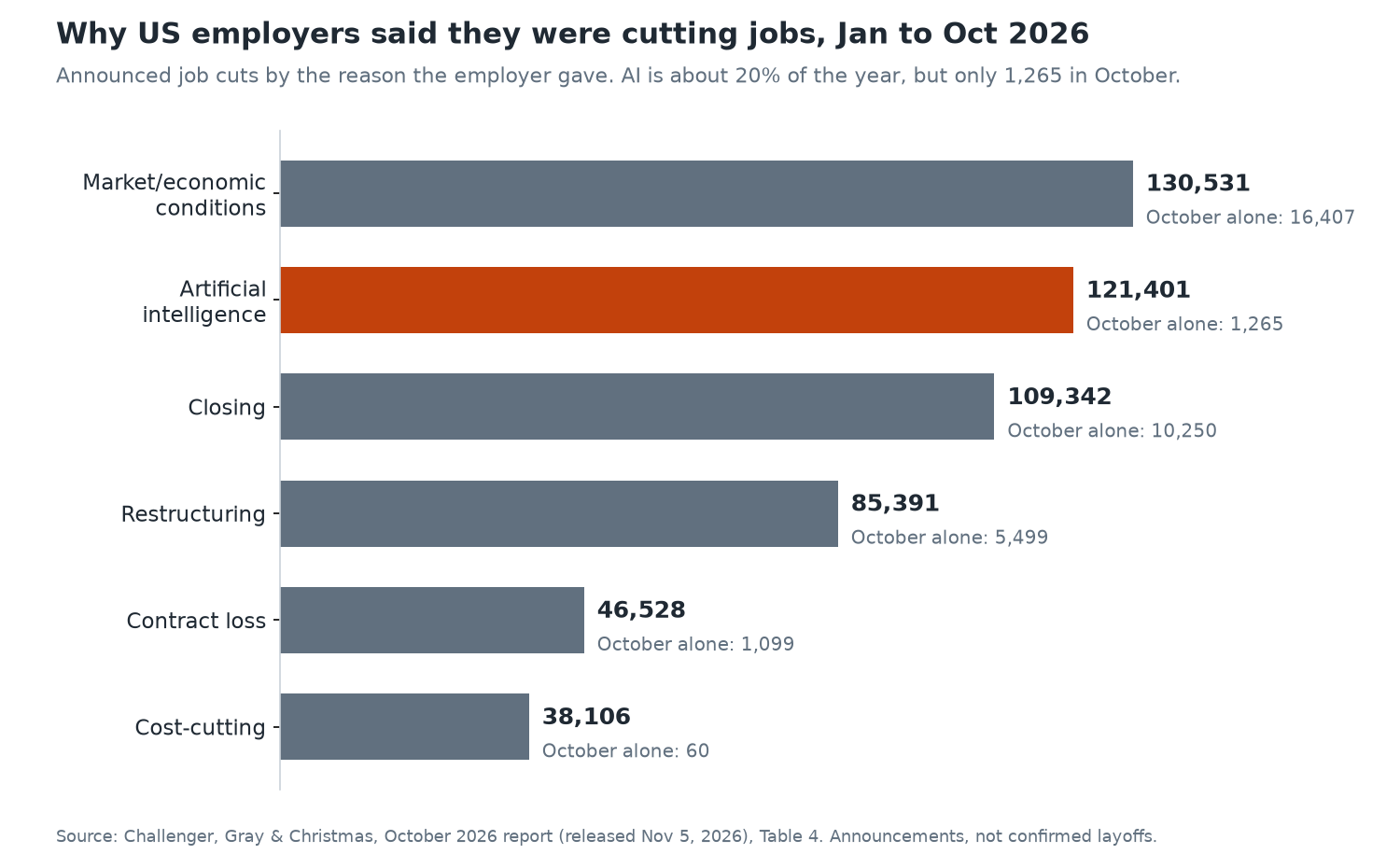
The numbers, checked against the report itself:
- October’s US total was 43,994 announced job cuts. That is the lowest October since 2023 and down 71% from October 2025.
- Employers cited AI for 1,265 of those cuts. That is AI’s lowest month of 2026.
- For the year so far, AI has been cited for 121,401 cuts, about 20% of the total. That is a lot. But “market and economic conditions” has now passed it as the top reason, at 130,531.
- Technology companies have announced 171,501 cuts this year, 28% of all cuts and already more than all of 2025.
- FinTech is small but up sharply: 11,979 cuts so far this year, against 1,863 by this point last year.
Andy Challenger said the reasons employers give have moved from technology toward the economy. Here is the part I keep coming back to. Challenger counts the reason the employer states. If a company says “restructuring” when AI is part of it, it lands in restructuring. If a company says “AI” when the real driver is cost, it lands in AI. The count tells you what companies chose to say, which is useful, but it is not proof of what caused the cut.
What the official survey data says
The UK’s Office for National Statistics asked businesses directly. In its July 2026 analysis, among businesses using AI to improve how they run, 63% said their headcount had not changed because of it, 6% said it went down and 1% said it went up. The most common way firms said they were bringing in AI skills was training or retraining the staff they already had (ONS).
One honest catch. That survey leaves out finance and insurance. So it cannot tell us much about banks specifically, which is exactly where Barclays, NatWest and others are now making cuts.
Confirmed and not known
Confirmed, from Barclays’ own documents or on-record statements:
- About 5,000 full-time roles, about 5% of staff, with about 1,000 already gone.
- Around 60% in support functions, including developers.
- Call centre volumes down about 10% and branch staffing down about 10% in the UK retail bank.
- A £500m buyback and £2.3bn quarterly pre-tax profit announced the same day.
Not known:
- How many of the 5,000 are because AI now does the work. The CEO was asked and did not give a figure.
- Exactly which teams and countries. The BBC reported that a significant share is expected in India, where some UK back office work is done, but no breakdown has been published that I could find.
- Whether some cuts will come through not refilling roles rather than layoffs. Barclays did not split that out.
I also did not find any newer Barclays announcement since October 22 that changes these numbers. City AM reported on November 3 that NatWest’s staff count fell by 1,000 last quarter, but NatWest’s boss said no single change explained it (City AM).
Who this affects
- Bank staff in support and back office roles: operations, processing, internal IT, and the people who build and maintain internal software.
- Contact centre and branch staff, where Barclays already reports about 10% fewer people per branch and fewer calls.
- Developers in any large company. Barclays has now said on the record that AI tools mean it needs fewer of them.
- Workers at offshore service centres that do UK back office work.
What I would do if I worked there
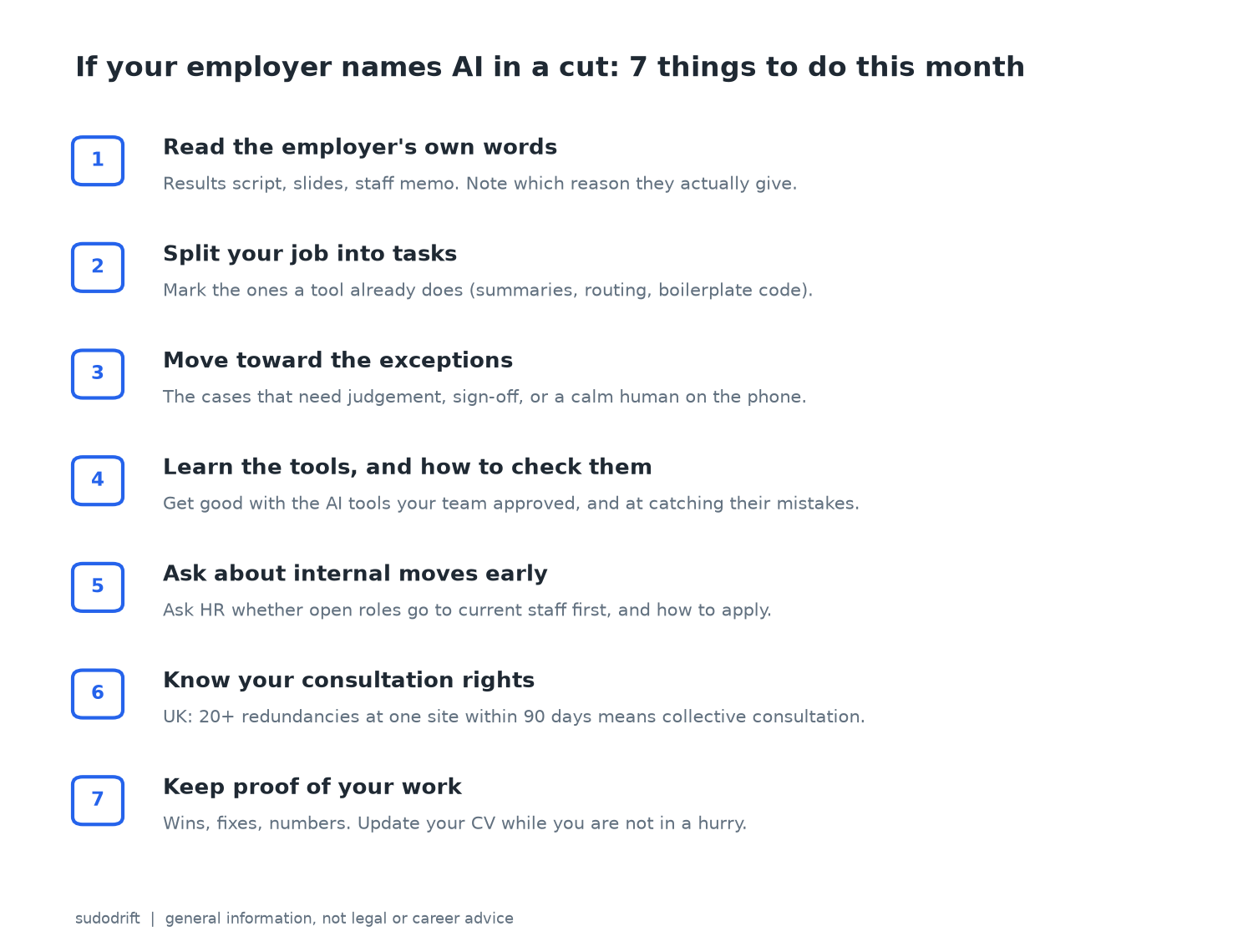
I work in IT. I am not a career coach and this is not legal advice. But this is what I would actually do this month.
-
Read the source, not the headline. Most listed companies publish their results script and slides. Search them for “efficiency”, “FTE” and “AI”. Note which reason they give for which cut. It tells you whether your team is in the “tech does the work” pile or the “cost target” pile.
-
Break your job into tasks. Write down what you do in a week. Mark the parts a tool already does or could do soon: summarising calls, routing tickets, writing boilerplate code, filling standard forms. Be honest. Those tasks are where the headcount maths happens.
-
Move toward the exceptions. The work that stays with people tends to be the messy part. The angry customer whose case does not fit the script. The payment that failed for a strange reason. The change that needs someone to sign off and own the outcome. Barclays itself says branch staff are now focused on higher value support. If you can be the person who handles what the tool cannot, you are harder to cut.
-
Learn the tools your team is already using. If AI is making the developers who stay more productive, you want to be one of them. That means getting good with the coding assistant your company approved, and also getting good at checking its output. Someone has to catch the bug it wrote.
-
Ask about internal moves now, not after the letter. According to Bloomberg, as reported by Banking Dive, Barclays told staff it would put about £150m into skills by 2030 and fill open jobs with existing staff first. Whatever your employer, ask HR how internal moves work and how to apply before cuts are final.
-
Know your consultation rights. In the UK, an employer planning 20 or more redundancies at one site within 90 days must follow collective consultation rules, and must give written reasons and selection criteria to staff representatives (GOV.UK). If you are in a union, talk to your rep. Outside the UK the rules differ, so check your own country’s labour office.
-
Keep proof of your work. Save numbers on what you fixed, sped up or saved. Update your CV while you are calm, not in a panic the week the list comes out.
My take
I think the honest reading of the Barclays news is this. AI is real and it is already changing how many developers and call centre staff a big bank thinks it needs. But a large part of this cut looks like a normal cost programme at a profitable bank, and “AI” is the word that travels best in a headline. Today’s Challenger report shows US companies are now quieter about naming AI, even while technology companies keep cutting.
For workers, both stories end in the same place. The tasks that are routine and easy to measure are the ones at risk, whatever label the company puts on the cut. The skills that still hold are judgement on the hard cases, owning a result, knowing how your systems really work, and being the person who checks what the tool produced. I would rather build those now than wait to find out which pile my job is in.
Want one short email a week on breaches, AI and what to do about them? Subscribe to Weekly Breach Notes at weeklybreachnotes.substack.com.
Sources
- Barclays, Q3 2026 Results Analyst and Investor Conference Call Speech (with slides), Oct 22, 2026: https://home.barclays/content/dam/home-barclays/documents/investor-relations/ResultAnnouncements/Q32026Results/Q326%20Results%20Call%20Management%20Speech.pdf
- BBC News, “Barclays cutting 5,000 jobs as it increases reliance on AI,” Oct 22, 2026: https://www.bbc.co.uk/news/articles/cm4g1p347qgxo
- Banking Dive, “Barclays to cut 5,000 employees this year,” Oct 22, 2026: https://www.bankingdive.com/news/barclays-cut-5000-employees-ai-q3-earnings-venkat/833747/
- CNBC, “Barclays to slash 5,000 jobs in AI efficiency push,” Oct 22, 2026: https://www.cnbc.com/2026/10/22/barclays-ai-jobs-cuts.html
- The Guardian, “Barclays to cut 5,000 jobs as bank’s bosses hail AI productivity advances,” Oct 22, 2026: https://www.theguardian.com/business/2026/oct/22/barclays-profits-up-as-uk-banks-brace-for-tax-increase-in-budget
- UNI Global Union, “UNI backs Unite as Barclays cuts 5,000 jobs and hands shareholders £500 million,” Oct 23, 2026: https://uniglobalunion.org/news/uni-backs-unite-as-barclays-cuts-5000-jobs-and-hands-shareholders-500-million/
- City AM, “Barclays and Natwest layoffs signal start of banking’s AI job squeeze,” Nov 3, 2026: https://www.cityam.com/barclays-and-natwest-layoffs-signal-start-of-bankings-ai-job-squeeze/
- Challenger, Gray & Christmas, “October Layoffs at Three-Year Low; Seasonal Hiring Plans Up 26%,” Nov 5, 2026: https://www.challengergray.com/blog/october-layoffs-at-three-year-low-seasonal-hiring-plans-up-26/ (full report PDF: https://www.challengergray.com/wp-content/uploads/2026/11/Challenger-Report-October-2026.pdf)
- Office for National Statistics, “Artificial intelligence in UK businesses: 2023 to 2026,” Jul 20, 2026: https://www.ons.gov.uk/businessindustryandtrade/business/businessservices/articles/artificialintelligenceinukbusinesses/2023to2026
- GOV.UK, “Making staff redundant: Redundancy consultations”: https://www.gov.uk/staff-redundant/redundancy-consultations
Subscribe to Weekly Breach Notes for one breach a week and the fix that goes with it.